
This summer, my classroom vocabulary routine was featured on the Science of Reading Classroom Substack in a piece titled An Explicit and Integrated Vocabulary Routine. When I created the routine, I spent considerable time trying to develop something that was effective, efficient, and aligned with my required district curriculum. But as I continue to learn, I also continue to tweak and refine the routine.
This summer, I listened to researcher Dr. Freddy Hiebert present on using AI to support language learning. I was intrigued by her presentation and agreed with her observation that the words selected by curriculum companies often have little to do with one another. According to Hiebert, “It is the meanings that link words in our mental dictionaries, but we need to give those categories to kids to illustrate how they are related.”
I decided to follow her advice and experiment with using AI to create connected categories for the words in my curriculum. I listed the seven words from our unit and asked ChatGPT to create two or three categories that would connect the words. The results from our first unit on Nursery Rhymes are pictured below.
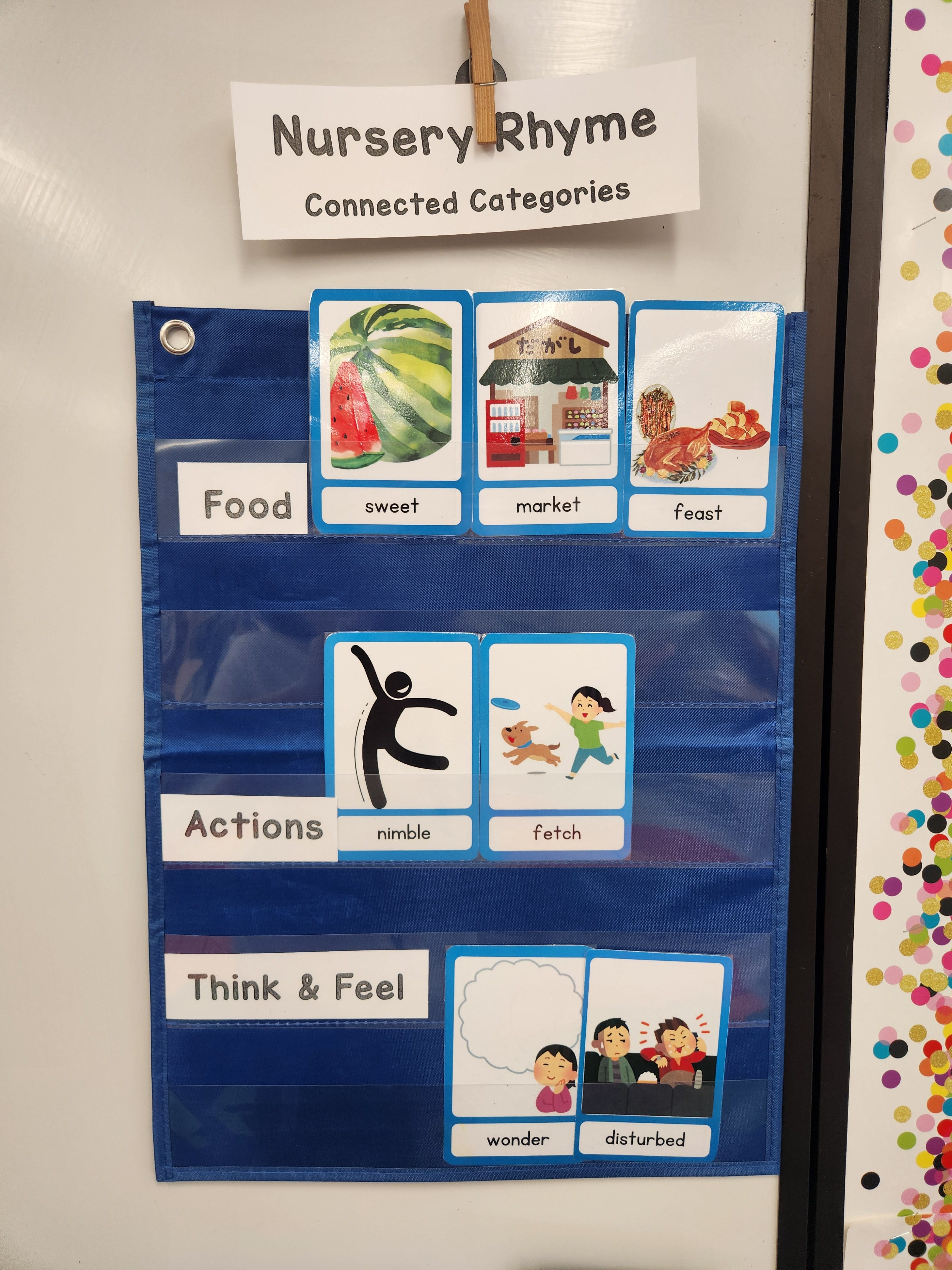
My students enjoyed thinking about where each word belonged and explaining why they thought a word should be placed in a particular category. The discussion also brought misconceptions to the surface, which gave us an opportunity to address and correct them. Anecdotally, I do feel that the activity helped students make connections between the new words and words already in their mental lexicons.
My students also scored higher on this year’s end-of-unit vocabulary assessment. However, they are a different group of students, and my class is smaller this year, so I recognize that the data is not a clean comparison. I certainly cannot attribute the improvement to this one change. Still, I believe this is a small adjustment that will benefit my students.
I have also been following Sean Morrissey and his Word Mapping Project, and I was inspired by his use of opposites. When my curriculum provides examples and non-examples, it might ask students to determine whether something is sweet or not sweet, or nimble or not nimble. Instead, I am choosing to substitute the word’s opposite. For example, we can discuss sweet and sour or nimble and awkward. This second small tweak exposes students to additional words while providing a meaningful way to illustrate how those words are related—again, reflecting what Dr. Hiebert advocates.
Dr. Margaret McKeown has written, “Vocabulary knowledge is the linchpin of comprehension.” With these small changes, I am hoping to strengthen this essential knowledge and help my students become more successful readers and writers. Even in the youngest grades, we need to focus on both sides of the reading rope.
For me, this is what professional learning looks like: learning something new, trying it with my students, paying attention to what happens, and continuing to refine my practice.
I love this, and will try it in a 3rd grade classroom this week
So smart! Love these tweaks